Inzone M10S Specs, Features, and Value: Is it worth the price tag?
Introduction
The landscape of competitive gaming monitors has shifted dramatically over the past few years. While 4K resolution and massive screen real estate have their place for cinematic experiences, the high-stakes world of professional esports has moved toward a "quality over quantity" approach regarding pixels. Speed, motion clarity, and latency reduction are the primary currencies of the modern competitive gamer. Entering this arena with a statement of intent is the Sony Inzone M10S, an OLED gaming monitor developed in collaboration with Fnatic, one of the world’s most successful professional gaming organizations. This partnership is not just marketing fluff; it signals a shift in design philosophy for Sony, moving away from the more lifestyle-oriented features of previous Inzone models and toward the surgical precision required by tactical shooter athletes.
The Inzone M10S isn't just another addition to an overcrowded market of 27-inch monitors. It represents a specific technological convergence: the infinite contrast and instantaneous response times of OLED technology paired with a blistering 480Hz refresh rate. For years, gamers had to choose between the visual beauty of OLED and the raw speed of TN or fast IPS panels used in the 360Hz and 540Hz categories. The M10S aims to bridge that gap, offering a monitor that looks stunning in HDR while providing a competitive edge that is, quite literally, as fast as current consumer technology allows. In this deep dive, we explore whether the M10S justifies its premium positioning by examining its technical specifications, real-world utility, and overall value proposition for both the casual enthusiast and the aspiring professional.
Design and Build: Purpose-Driven Aesthetics
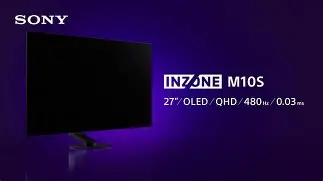
First impressions of the Inzone M10S reveal a departure from the "mini-PS5" aesthetic found in the original M9 monitor. Sony has traded the tripod stand for a much more functional, low-profile circular base. This is a critical design change driven by feedback from professional players. In titles like VALORANT or Counter-Strike 2, players often position their keyboards at extreme angles and keep their mousepads very close to the monitor. A bulky tripod stand consumes valuable desk territory, whereas the M10S’s compact 4mm thick base allows for maximum freedom of peripheral movement. This level of ergonomics is often overlooked by casual users but is a major selling point for those who play with low mouse sensitivity and require large sweeping arm movements.
The monitor maintains a sleek, professional look with a high-quality plastic chassis that feels robust. The build quality suggests longevity, and the heat management system—essential for preserving the life of an OLED panel—is integrated discreetly. The stand offers comprehensive adjustments, including tilt, swivel, and height, ensuring that users can achieve the perfect ergonomic alignment. Connectivity is equally thoughtful, featuring DisplayPort 2.1 and HDMI 2.1 ports. While many current GPUs hasn't fully saturated the potential of DP 2.1, its inclusion makes the M10S a future-proof investment for the next generation of high-end graphics cards.
The Technical Powerhouse: 480Hz OLED
The centerpiece of the Inzone M10S is the WOLED panel, developed in conjunction with LG Display. While 240Hz OLEDs have become relatively common, the jump to 480Hz is a transformative leap for motion clarity. To understand why this matters, one must look at "motion blur" in the context of sample-and-hold displays. Even if a pixel responds instantly (as OLEDs do in 0.03ms), the human eye perceives blur as the image persists on the retina while the eye tracks movement. By doubling the refresh rate from 240Hz to 480Hz, the amount of time each frame is displayed is halved, resulting in a significantly clearer image during fast-paced horizontal pans—the exact type of movement common in shooters.
The resolution is 2560 x 1440 (QHD), which is widely considered the "sweet spot" for 27-inch displays. It provides enough pixel density for sharp text and detailed environments without being as taxing on hardware as 4K. For a monitor aiming at 480Hz, 1440p is a pragmatic choice; even the most powerful modern PCs struggle to push 400+ frames per second at higher resolutions in modern titles. By staying at 1440p, Sony ensures that the 480Hz ceiling is actually attainable in esports titles like Overwatch 2 or Apex Legends.
24.5-inch Mode: The Professional Choice
One of the most unique features of the M10S is the dedicated 24.5-inch mode. Many professional players prefer the smaller 24-inch form factor because it allows them to see the entire screen within their peripheral vision without moving their head. Typically, using a 27-inch monitor for this involves awkward windowed modes or losing resolution quality. The M10S allows users to display a 1332p or 1080p image in a 1:1 pixel mapped area in the center of the 27-inch screen. You can choose to have black borders around the image, effectively turning the M10S into a pro-spec 24-inch monitor. For gamers who participate in tournaments where 24-inch screens are the standard, this allows for seamless practice at home on the exact same viewing angles they will encounter on stage.
Shop the latest Electronics picks on Amazon.
Shop Amazon →Performance in Practice: Beyond the Specs
Testing the M10S in a competitive environment reveals the true impact of the low latency. Input lag is essentially non-existent, creating a "one-to-one" feeling between mouse movement and on-screen action. In a game like Counter-Strike 2, where "peeking" an angle happens in milliseconds, the M10S provides a level of visual information that can be the difference between a win and a loss. You see the enemy’s shoulder pixels a fraction of a second earlier than you would on a standard 144Hz or even 240Hz screen.
However, the M10S isn't just a "speed demon." Because it is an OLED, it excels in single-player, atmospheric games as well. With a peak brightness of 1300 nits in HDR and VESA DisplayHDR True Black 400 certification, the contrast is spectacular. Deep space in titles like Starfield or the neon-soaked streets of Cyberpunk 2077 look vastly better here than on any IPS-based gaming monitor, no matter how many local dimming zones it possesses. The color gamut coverage is also impressive, covering 98.5% of the DCI-P3 space, making colors vibrant and accurate right out of the box.
Comparing the Specs: M10S vs. Competitors
To understand the M10S's place in the market, it is helpful to see how it stacks up against other high-end monitors. While standard 240Hz OLEDs are its most direct price competition, its speed puts it in a class shared only by a few other 480Hz models.
| Feature | Sony Inzone M10S | Typical 240Hz OLED | 540Hz TN Panel |
|---|---|---|---|
| Panel Type | WOLED (LG) | QD-OLED / WOLED | TN |
| Refresh Rate | 480Hz | 240Hz | 540Hz |
| Response Time | 0.03ms (GtG) | 0.03ms (GtG) | 0.1ms - 1ms |
| Contrast Ratio | 1,500,000:1 | 1,500,000:1 | 1,000:1 |
| Resolution | 2560 x 1440 | 2560 x 1440 / 4K | 1920 x 1080 |
| Best Use Case | Elite Esports + HDR | General High-End Gaming | Pure Competitive (Low Vis) |
Pros and Cons: A Balanced View
When critiquing a piece of hardware that costs nearly a thousand dollars, it is important to look at both the triumphs and the inherent trade-offs of the technology chosen.
- Pro: Unmatched Motion Clarity - The combination of a 480Hz refresh rate and OLED response times creates the clearest moving image available in the 1440p market.
- Pro: Versatile Display Modes - The 24.5-inch mode is a game-changer for serious esports competitors who alternate between casual and tournament settings.
- Pro: Superior Ergonomics - The new base design is a massive improvement over previous Sony models, acknowledging how pro gamers actually use their desks.
- Pro: Visual Fidelity - Unlike high-speed TN panels, the M10S doesn't sacrifice color or contrast for speed. It is a world-class HDR display for movies and AAA games.
- Con: Price Premium - The M10S carries a significant "early adopter" tax. You are paying for the cutting edge of panel technology.
- Con: Text Clarity Issues - Like many OLED panels with unique subpixel layouts, some users may notice slight fringing on text during productivity tasks, though it is minimal on this second-generation panel.
- Con: Burn-in Concerns - Though Sony has included protective features, the risk of permanent image retention is a perennial concern with OLED tech, especially if you use the monitor for 8+ hours of static desktop work daily.
Buying Guide: Is the M10S Right for You?
Choosing a monitor of this caliber requires an honest assessment of your gaming habits and your PC hardware. Before clicking the "buy" button, consider the following factors to ensure you are making a sound investment.
Your PC Hardware
There is no point in owning a 480Hz monitor if your PC can only output 120 frames per second. To truly take advantage of the M10S, you ideally need a modern, high-end CPU (like an AMD Ryzen 7 7800X3D or an Intel i9-14900K) and a powerful GPU. While esports titles are less demanding, hitting a stable 480 FPS at 1440p requires significant horsepower. If you are running mid-range hardware from three or four years ago, you might find that a 240Hz OLED provides a similar experience for a few hundred dollars less.
Usage Ratios: Gaming vs. Work
If you are a professional video editor or someone who spends most of your day in Excel and Word, an OLED might not be your best primary monitor. The risk of burn-in from static UI elements is real, and the subpixel structure isn't as crisp for small black-on-white text as an IPS or VA panel. However, if your monitor usage is 70% gaming and media consumption and 30% light productivity, the M10S is perfectly viable.
Looking for the best Electronics deals on Amazon?
View Offers →Competitive Intent
Buyers who will get the most value out of the M10S are those who play "twitch" shooters. If your primary library consists of Baldur's Gate 3, Microsoft Flight Simulator, or Elden Ring, the jump from 240Hz to 480Hz will be almost imperceivable. Those games simply aren't fast enough to benefit from the increased temporal resolution. The M10S is built for the player who tracks an Octane in Apex Legends or tries to click a head in a high-speed Valorant execute.
The "Total Package" Factor
One of the strongest arguments for the M10S is that it eliminates the need for a dual-monitor setup. Historically, many enthusiasts had a TN panel for competitive play and a 4K IPS or OLED panel for "pretty" games. The M10S is the first monitor that arguably does both at a best-in-class level. By purchasing one M10S, you are getting a pro-level esports tool and a premium HDR cinema screen in one chassis.
The Verdict: Is it Worth the Price?
The Sony Inzone M10S sits at the absolute peak of current display technology. It is a specialized tool that happens to have broad appeal. For the vast majority of gamers, a standard 144Hz or 240Hz monitor will be more than sufficient. However, the "worth" of the M10S is found in its lack of compromise. Usually, when you buy a "fast" monitor, you accept poor viewing angles, washed-out colors, and terrible contrast. When you buy a "beautiful" monitor, you accept motion blur and slower input response. The M10S refuses to make that trade.
For the competitive gamer who also wants to enjoy the latest blockbuster title in stunning HDR, the M10S represents a definitive peak in the market. The inclusion of the 24.5-inch practice mode and the refined stand design shows that Sony was listening to the community. While the price tag is high, it reflects the reality of the OLED market: you are paying for the most advanced panel currently available. If you have the hardware to drive it and the passion for competitive play to utilize it, the Inzone M10S is not just a monitor; it is a significant competitive advantage that doubles as a visual masterpiece.
Conclusion
The Sony Inzone M10S is a testament to how far gaming displays have come in a short time. By marrying the speed of professional-grade TN panels with the infinite contrast of OLED, Sony has created a product that feels like the future. It is a niche product, certainly, but one that fills its niche with incredible competence. As the industry moves closer to high-frame-rate gaming as a standard, the M10S stands as a benchmark for what is possible when design meets raw performance. Whether it is worth the price depends entirely on how much you value those extra milliseconds of clarity—and for those at the top of their game, those milliseconds are worth everything.